Public Health

summit of mayors
Summits

6th APCAT Summit

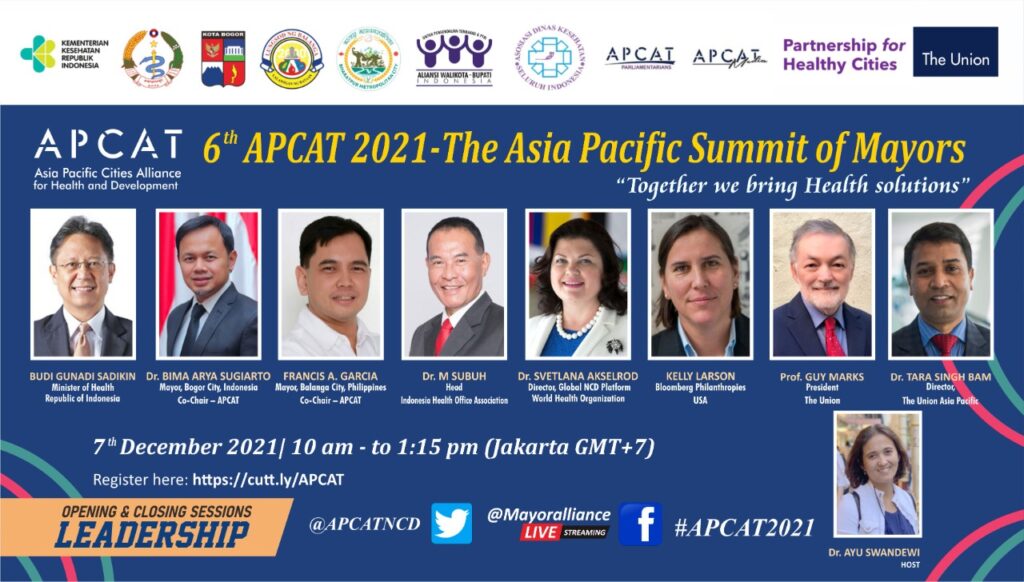
6th APCAT SUMMIT The 6th Asia Pacific Summit of Mayors (6th APCAT Summit) was held virtually on 7 December 2021 with the theme, “Together we bring health solutions”. The summit brough together over 800 delegates from 130 cities in 19 countries including Mayors, Governors, public health experts, media, and youth. The 6th APCAT Summit delegates adopted the Declaration which commits subnational leaders for stronger action in advancing tobacco control, preventing NCDs, leveraging synergies between COVID-19 response and other health and development responses, and firewalling health and development policies and programmes from industry interferences. Moreover, it highlights the needs of sustaining routine vaccination programs, TB control and preventing mother to child transmission of viral hepatitis during pandemic to prevent secondary health crisis. “Bogor City has achieved 89.05% Covid vaccination rate which is highest in West Jawa, Indonesia. I had instructed the hospitals in Bogor City to identify those who use tobacco because tobacco use can cause co-morbidities and lung diseases which put people at higher risk of Covid serious outcomes. That is why I ensured tobacco control activities continued during the pandemic as those who suffered severe Covid disease have been heavy smokers as well. Stopping smoking is part of Covid prevention protocol campaign in Bogor City” said Dr Bima Arya Sugiarto, Mayor of Bogor City in Indonesia, and co-Chair of APCAT. “Tobacco control is an issue that requires multisectoral cooperation” said Francis A Garcia, Mayor of Balanga City in Philippines, and co-Chair of APCAT. That is why Mayors and other subnational leaders who are best placed to synergise multisectoral response locally for advancing tobacco control and prevention of non-communicable diseases, have united as APCAT. Today “subnational leaders of 78 cities from 12 countries in Asia Pacific region form APCAT”. “Despite set back the pandemic imposes; Indonesia is committed to reduce youth smoking prevalence. To achieve this, Ministry of Health continues to advocate to impose the highest attainable taxes on tobacco products, adopt 90% pictorial health warnings on tobacco packaging and forbid the selling of single stick of cigarette and regulate electronic cigarettes,” said Budi Gunadi Sadikin, Minister of Health, Republic of Indonesia. “The Union strives to end suffering due to tuberculosis and lung diseases, old and new, by advancing better prevention and care. We must ensure that no-one is left behind, people are treated equally and we have a focus on vulnerable and marginalised populations and communities,” said Dr Guy Marks, President of the International Union Against Tuberculosis and Lung Disease (The Union). “The problems are complex but the solutions are in the policy makers’ hands.” “The double pandemic of the COVID-19 and noncommunicable diseases places us in an unprecedented crisis that cannot be solved by a single country or stakeholder. Only by scaling up global cooperation to bring together governments, WHO and other UN agencies, civil society, academia, and the private sector can we make progress towards a successful recovery and achieve SDG target 3.4, and universal health coverage” said Dr Svetlana Akselrod, Director of Global NCD Platform, World Health Organization. “During COVID-19 pandemic, the tobacco industry tried to intensify their Corporate Social Responsibility (CSR) Campaigns and build relationships with the government. Countries need to incorporate the Article 5.3 of the FCTC into their domestic laws in order to prohibit influence of tobacco companies over tobacco control policies making” said Dr Gan Quan, Director for Tobacco Control, International Union Against Tuberculosis and Lung Disease (The Union). “Tobacco control is an issue that requires multi-sectoral cooperation. The mayors’ alliance has made a great stride in promoting tobacco control throughout the Asia Pacific region. The Alliance is also a critical platform for sharing best practices and lesson learned among leaders” said Kelly Larson, Bloomberg Philanthropies. “Tobacco control is an issue that requires multisectoral cooperation” said Francis A Garcia, Mayor of Balanga City in Philippines, and co-Chair of APCAT. That is why Mayors and other subnational leaders who are best placed to synergise multisectoral response locally for advancing tobacco control and prevention of non-communicable diseases, have united as APCAT. Today “subnational leaders of 78 cities from 12 countries in Asia Pacific region form APCAT”. APCAT is a unique regional alliance of 78 mayors and sub-national leaders from 78 cities of the 12 countries (Bangladesh, Cambodia, India, Indonesia, Lao PDR, Malaysia, Myanmar, Nepal, Philippines, Singapore, Timor-Leste and Vietnam) in Asia Pacific that work collectively to gain political commitments to offer local solutions for local problems. It believes that the role of subnational leaders is the key to bring change through good city-level governance. They have also unique capacities of creating, maintaining, activating cross-sectors alliances/networks; fostering public-private partnerships; bridging subnational and national public health politics; implementing health interventions and sharing lessons learned. The 6th APCAT summit was jointly organised by Asia Pacific Cities Alliance for Health and Development (APCAT), Ministry of Health, Republic of Indonesia; National Centre for Health Promotion, Ministry of Health, Cambodia; Bogor City, Indonesia; Balanga City, Philippines; Bharatpur Metropolitan, Nepal; Indonesia Mayor and Regent Alliance; Association of All Health Offices Indonesia (ADINKES), APCAT Parliamentarians, APCAT Media, Partnership for Healthy Cities and The International Union Against Tuberculosis and Lung Disease (The Union). The Union Asia Pacific Office is the alliance secretariat. 6th APCAT SUMMIT OPENING HIGHLIGHTS https://www.youtube.com/watch?v=DFP_Sc5n_ag

, , , , ,

6th APCAT Summit Read Post »

apcat summit 3
Summits

3rd APCAT Summit

3rd APCAT SUMMIT Political leadership and commitment play a critical role in Tobacco control. Building and enhancing national and sub-national capacities for tobacco control in every country is an urgent priority and one of the most significant measures required to effectively combat the tobacco epidemic. Strong sub-national leadership will ensure effective measures of tobacco control by identifying local solutions to local problems in the region. APCAT (Asia Pacific Cities Alliance for Tobacco Control and NCDs Prevention) aims to build a strong tobacco and NCDs control programme through political commitments, new partnership opportunities, sustainable and effective utilization of the resources, and stronger public health system performance and outcomes. The 3rd Summit of AP-CAT was held in Singapore from the 4th to the 6th of December 2018 in Singapore. A total of 12 countries participated in 2018 growing from 10 in 2017 and before that 9, in 2016. The host country, Singapore, offered a solid example of how effective and well-enforced tobacco control laws can impact public health nationwide. The summit was opened by Mr Edwin Tong, Senior Minister of State for Health. “ I am encouraged by the many officials and healthcare experts present this evening, and would like to thank the International Union Against Tuberculosis and Lung Disease for bringing together this wealth of experience in regional tobacco control. This Summit is a good opportunity for everyone to share their insights and perspectives on our common fight against tobacco use, and bring about a reduction in the non-communicable disease burden in our respective countries. I am confident that together, we will stand united to improve the health of our people.” ~ MR EDWIN TONG, SENIOR MINISTER OF STATE FOR HEALTH, read the full speech here 3rd APCAT SUMMIT OPENING HIGHLIGHTS https://youtu.be/Tvrt_P1-Ljs?feature=shared

, , , , , , , , ,

3rd APCAT Summit Read Post »

asia pacific cities alliance for tobacco control
Summits

2nd APCAT Summit

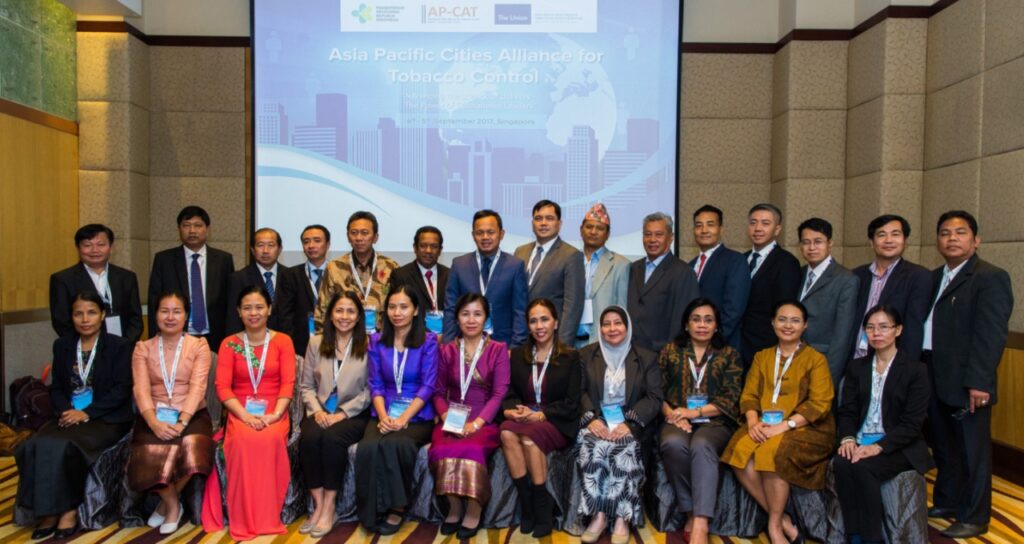
2nd APCAT SUMMIT Mayors and health officials representing 21 cities from 10 Asia Pacific countries concluded a two-day tobacco control conference with a commitment to introduce and enforce policies proven to reduce tobacco use within their jurisdictions. The Asia Pacific Alliance for Tobacco Control [AP-CAT] was hosted in Singapore 4 – 5 September, and was organised by The Union and Indonesia’s Ministry of Health. Attendees were from Indonesia, Singapore, Viet Nam, Philippines, Myanmar, Malaysia, Timor Leste, Lao PDR, Nepal and Cambodia. AP-CAT was formed in 2016 to create a network and forum for subnational leaders working to advance tobacco control. Smoke-free public places and advertising bans are within their remit. ‘Together we can improve the health of our people by taking a united stand on tobacco control,’ said Mr Chee Hong Tat, Senior Minister of State, Ministry of Health & Communications and Information, Singapore ‘Singapore has adopted a multi-pronged approach to tobacco control, which includes legislation, taxation, public education and helping smokers to quit.’ The Asia Pacific region has some of the highest rates of tobacco use in the world. The tobacco industry aggressively targets countries with weak tobacco control laws to recruit new generations of users through powerful marketing campaigns. APCAT members are focused on the World Health Organization’s MPOWER series of policies – which are proven to reduce tobacco use across populations. AP-CAT’s membership has doubled in the last year, demonstrating the growing political will for tobacco control at subnational level. The Union Asia Pacific office is secretariat for the alliance. ‘Despite the challenges, we are committed to expanding our work on smoke-free implementation at the sub-national level, enlarging of graphic health warnings on tobacco packaging to at least to 75 percent, and banning all types of tobacco advertising and promotion with a national law,’ said Dr H. Subuh, Director General of Disease Prevention and Control for the Indonesian Government. He said the Ministry of Health was also working to raise taxes on tobacco through coordination with the Ministry of Finance. ‘Tobacco control is a best buy for public health, whether at the national or sub-national level,’ said AP-CAT chair Dr Bima Arya Sugiarto, mayor of Bogor, Indonesia. ‘In Bogor city there has been no loss of revenue following the ban on tobacco advertising. In fact, contrary to the tobacco industry’s claims, there has been a significant increase.’ ‘Our collective action will bring public health solutions to the people,’ said APCAT co-chair Francis Anthony S Garcia, mayor of Balanga city, Philippines. ‘We will work together to prevent tobacco industry interference in these life-saving policies.’ By end of the meeting, the APCAT released a call to action with 8 main recommendations and commitments. The alliance also made a decision to widen its focus to Noncommunicable diseases. Therefor APCAT will from now onwards, read as, “Asia Pacific Cities Alliance for Tobacco Control and NCD Prevention”

, , , , , , , , ,

2nd APCAT Summit Read Post »

people posing
All, Summits

1st APCAT Summit

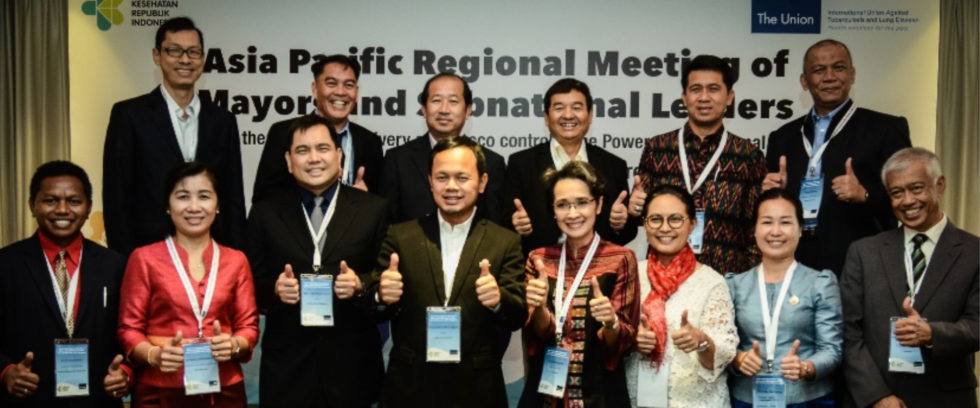
On the 29th to the 30th of November, Mayors, Subnational Leaders and high-ranking government officials came together in Singapore to discuss tobacco control. The delegates were from 9 countries and 15 cities/districts from all around Asia Pacific. This meeting was jointly organised by The International Union Against Tuberculosis and Lung Disease together with The Ministry of Health, Republic of Indonesia.

, , , , , , , , ,

1st APCAT Summit Read Post »

Ending-Epidemics_English
All, Events

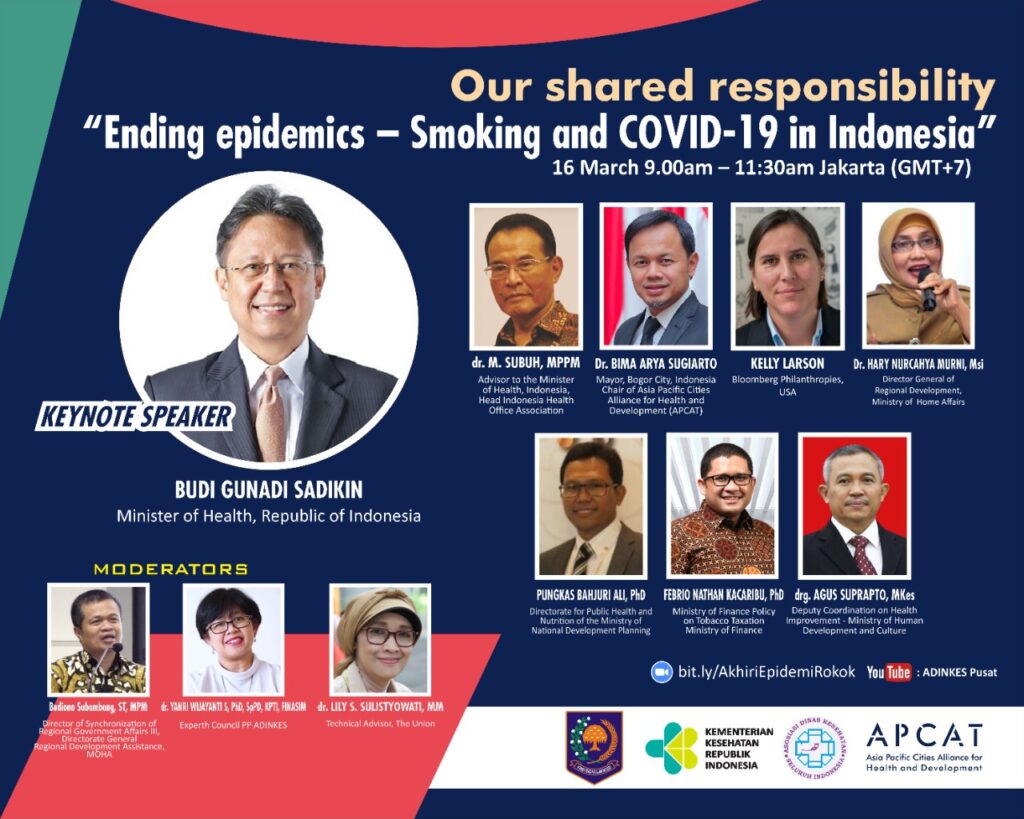
Our Shared Responsibility – Ending Epidemics: Smoking and COVID-19 in Indonesia

A National webinar entitled “Our Shared Responsibility, Ending Pandemics: Smoking and COVID-19 in Indonesia was held to consolidate efforts for tobacco control in the country.

, , , , , , , , ,

Our Shared Responsibility – Ending Epidemics: Smoking and COVID-19 in Indonesia Read Post »

Scroll to Top