
Strong subnational leadership can combat the tobacco epidemic across Asia Pacific.
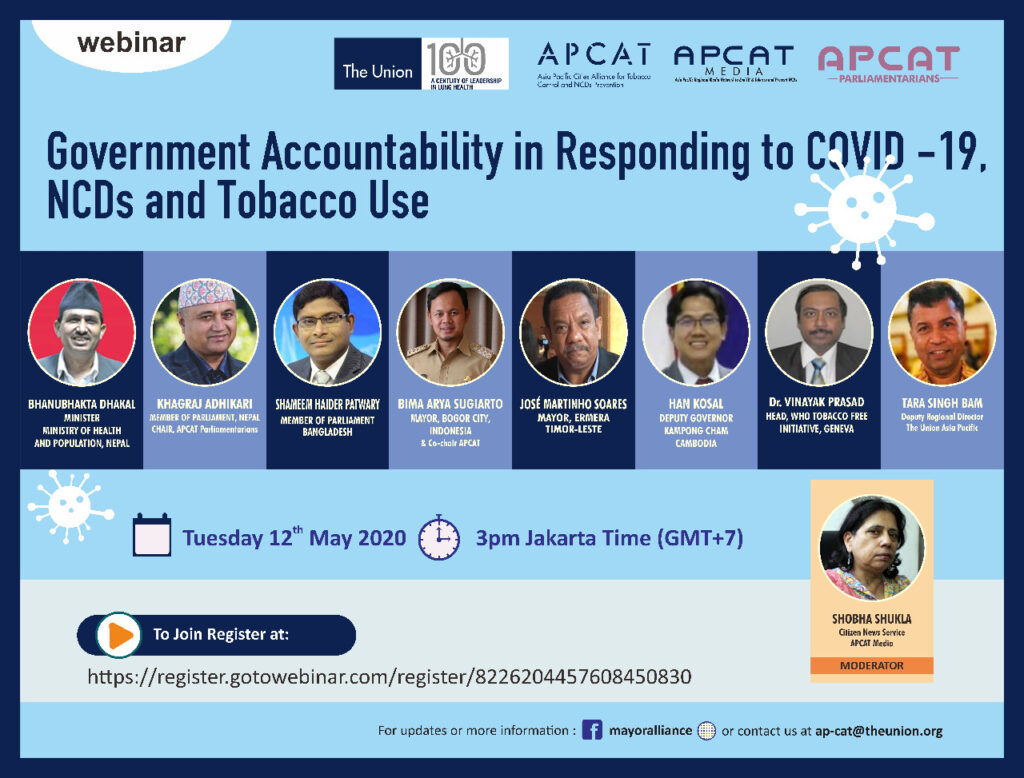
APCAT (Asia Pacific Cities Alliance for Tobacco Control and NCDs Prevention), APCAT Parliamentarians, APCAT Media, and the International Union Against Tuberculosis and Lung Disease (The Union) co-hosted a webinar entitled “Government Accountability in Responding to COVID-19, NCDs and Tobacco Use.”
The event was attended by 514 participants from 49 countries, representing national and subnational governments, academia, civil society, health professionals, professional organizations, students, and media.
Key Issues Highlighted
- The Asia Pacific region accounts for 2.3 million of the 8 million global tobacco-related deaths annually, and has the highest smoking rates worldwide, with two-thirds of men using tobacco.
- Tobacco use is a major risk factor for noncommunicable diseases (NCDs). Globally, 14% of all NCD deaths among adults over 20 are attributable to tobacco.
- Evidence shows that individuals with pre-existing NCDs are especially vulnerable to severe COVID-19 outcomes.
Expert Insights
- Dr. Vinayak Prasad (WHO) emphasized that smokers are more likely to develop severe COVID-19 compared to non-smokers. WHO recommends governments:
- Provide smoking cessation services (quit lines, counseling, etc.).
- Ban waterpipe smoking.
- Increase taxes on tobacco and alcohol.
- Collect scientific data on tobacco use among COVID-19 positive cases.
- Khagraj Adhikari (Nepal, APCAT Parliamentarians Chair) called for stronger policies:
- Review and amend tobacco control laws.
- Raise taxes and prices of tobacco products.
- Restrict or ban tobacco and alcohol sales.
- Ban industry donations aimed at marketing harmful products.
- Ensure continuity of NCD and TB services during the pandemic.
- Hold governments accountable for public health.
- Dr. Bima Arya (Mayor of Bogor, Indonesia; APCAT Co-chair) highlighted local efforts:
- Enforcing social distancing measures with sanctions.
- Promoting tobacco abstinence to reduce COVID-19 risks.
- Maintaining smoke-free policies in public places, workplaces, and transport.
- Refusing donations from the tobacco industry (e.g., masks, sanitizers).
- Dr. Tara Singh Bam (The Union) praised the critical role of subnational leadership, noting that local governments are developing innovative solutions to tobacco control challenges.
Broader Significance
The webinar underscored that tobacco use is a preventable common risk factor for both COVID-19 and NCDs. Stronger health policies, budget approvals, resource mobilization, oversight, and enforcement of global and national commitments are essential for progress in:
- Tobacco control
- NCD prevention
- Primary healthcare services (including TB control)
Distinguished Speakers
Other notable contributors included:
- Shameem Haider Patwary, Member of Parliament, Bangladesh
- Han Kosal, Deputy Governor of Kampong Cham, Cambodia
- Jose Martinho Dos Santos Soares, Mayor of Ermera, Timor-Leste
The discussion was moderated by Shobha Shukla (Citizen News, APCAT Media).