
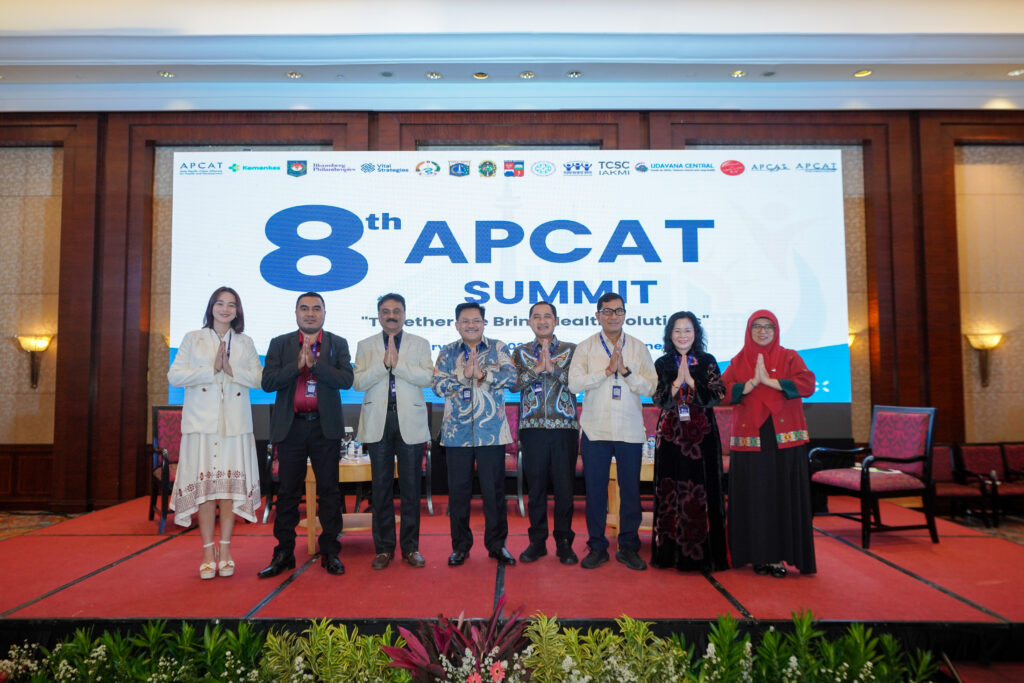
8th APCAT Summit Convenes in Jakarta: A Unified Call for Tobacco and Nicotine Free Cities.
Jakarta, 25-26 January 2026 – The 8th Asia Pacific Cities Alliance for Health and Development (APCAT) Summit brought together over 200 delegates from 41 cities across eight countries. This year’s event, themed “Together We Bring Health Solutions,” saw participation from 21 mayors, vice mayors, and governors, alongside public health specialists, academics, civil society representatives, youth, journalists, and public health professionals, all united in their commitment to address the pressing challenges posed by tobacco use and its associated health impacts.
Echoing the call for collaboration, Dr. Hasto Wardoyo, Mayor of Yogyakarta and newly appointed Chair of APCAT, stressed the importance of coordinated efforts. “Strong collaboration between national and subnational governments, supported by development partners and city networks, is essential,” he remarked, emphasizing that city leadership alone is insufficient to tackle complex public health challenges. Dr. Wardoyo takes over as leadership from Dr Bima Arya Sugiarto and Francis Anthony Garcia (Vice Mayor of Balanga City, Philippines) who held the positions for 10 years since 2016, steering alliance from its birth with 12 cities to 133 cities today.
Gan Quan, Senior Vice President of Tobacco Control at Vital Strategies, emphasized the critical role of effective policy implementation, stating, “Strong policies achieve their full impact only when they are effectively enforced.” He underscored the importance of prioritizing enforcement as a governance choice, which leads to cleaner public spaces and healthier communities, enhancing public confidence in government actions.
Addressing the growing concern surrounding alternative tobacco products, Vice Governor of Jakarta Province, Rano Karno, remarked, “The government is paying close attention to the rapid growth of e-cigarettes and other alternative tobacco products, especially among young people. The belief that these products are safer is misleading.” Vital Strategies has been closely collaborating with Jakarta Province which adopted a new smoke-free policy in December 2025 that prohibits smoking and vaping in all public places, workplaces, and public transport.
While the Asia Pacific region boasts diverse countries with unique challenges, it shares common obstacles to tobacco control akin to those worldwide. These include varying political commitment, social inequalities, and a focus on short-term tobacco tax revenue over the broader economic costs of tobacco use. Misconceptions about economic losses from tobacco control measures and distractions from other health crises further complicate efforts. However, alliances like APCAT play a crucial role in addressing these challenges by fostering collaboration, sharing best practices, and advocating for comprehensive tobacco control policies across the region.
Kelly Larson of Bloomberg Philanthropies reiterated the organization’s commitment to supporting local leadership and organizations in advancing evidence-based policies that reduce tobacco use and save lives. Drg Murti Utami, Director General of Disease Prevention and Control, Ministry of Health, Indonesia added that strengthening the implementation of Smoke-Free Areas (KTR) is crucial for breaking the cycle of access to cigarettes, serving as a protective instrument for vulnerable groups, especially children and adolescents.
The summit concluded with a significant declaration, wherein delegates recognized APCAT as a vital platform for sharing experiences and fostering collaboration across health and development programs. They acknowledged the immense toll of preventable deaths from tobacco use, noncommunicable diseases (NCDs), tuberculosis, and antimicrobial resistance, which severely undermine development. The delegates committed to implementing and sustaining comprehensive tobacco and nicotine-free policies, advocating for higher taxes on unhealthy commodities, ensuring accountability in public policy, and investing in tobacco control as a core prevention strategy for various health issues.
Dr. Bima Arya Sugiarto, Vice Minister of Home Affairs, called for “harmonisation of public health regulations” at global, regional, national and sub-national or local levels to help save lives and protect people’s health and wellbeing. He also called upon new leaders of APCAT to continue fostering leadership within this important alliance of sub-national governments. “We need to go beyond Declarations” he said underpinning the critical importance of translating words into action on the ground. He called to collaborate, co-create, innovate and regenerate.
APCAT, forged in 2016, has grown to encompass 133 cities across 12 countries, including Bangladesh, Cambodia, India, Indonesia, Lao PDR, Malaysia, Myanmar, Nepal, Philippines, Singapore, Timor-Leste, and Vietnam. The initiative aims to bolster political commitments, foster new partnerships, and enhance health system performance and outcomes. Vital Strategies, instrumental in APCAT’s formation, continues to play a coordinating role by providing technical advisement and strategic development for the alliance, underscoring the importance of collective action in tackling public health challenges.